
 0
0
 0
0
AI is Beauty AND the Beast
Nearly every Facebook page I follow—and a bunch that I don’t, which the Metagods are certain I should—spew AI-written clickbait like a vomiting toddler. You read a long, detailed account of some obscure mountain family no one ever heard of, and every paragraph is pitch-perfect, every minute detail neatly woven into a seamless narrative. You know the hacker in China behind the Hidden History of Texas (or somesuch) page isn’t typing out such inerrant beauty, driven by the spirit that has driven every writer worth his or her salt—the spirit of inspiration the reader can sense but cannot grasp and the writer can barely keep up with while pounding away on the keyboard.
No, they open ChatGPT, put in a prompt, wait for the collective intelligence to respond with blinding speed and mind-numbing precision, then type “yes” when asked by the Invisible, “Would you like me to write this one up for you, Moron?”
The result is flawless…
Syntax? Perfect! Proper Grammar? Stellar!
Never has one human written quite so well as the Collective. Never has a document passed the scrutiny of the editor so well. Not the Declaration of Independence. Not the King James Bible. Not even the Oxford Dictionary. All pale in comparison to the perfection achieved by Hacker Bob in Mountain Home, Arkansas, or Hanoi Henry of, well, Hanoi.
And no one is more annoyed by it than me.
I agree with the lazy Memer who said, “I would rather AI take care of my work and free me up for art, than take care of the art and free me up for work.”
I doubt that is a perfect quote. Ask ChatGPT, if you like.
I won’t wait.
Just read the last paragraph first!
One surefire way to recognize an AI-generated piece is to skip to the conclusion. They are always the same.
Hold on! Let me open up Facebook. I promise, I will only be a minute. I know I can find an example or three.
Here is a post from an egregious offender calling itself “Historical Facts.” Like all of its stories, it is a good one.
On Christmas Eve in 1955, a simple newspaper advertisement sparked an extraordinary tradition that continues to warm hearts worldwide. The ad encouraged children to call Santa Claus, providing a phone number for them to reach him. However, the number printed was incorrect. Instead of reaching the North Pole, the calls went directly to the U.S. Air Defense Command. Faced with dozens of excited children hoping to speak with Santa, the colonel on duty didn’t hang up. Instead, he instructed his team to track Santa’s “current location” and share it with the kids. This kind gesture turned a potential mishap into a beloved holiday tradition.
Since that first unexpected call, the program grew and evolved, becoming known as the North American Aerospace Defense Command’s (NORAD) Santa Tracker. Today, the operation handles calls from over 200 countries, with a team of volunteers providing children with updates on Santa’s journey as he delivers gifts around the world. The tradition combines technology, holiday spirit, and goodwill to create a magical experience for millions of families every year.
What started as a simple mistake became a symbol of generosity and holiday cheer. The NORAD Santa Tracker now uses satellites, radar, and fighter jets to create real-time updates about Santa’s progress, adding to the excitement for children waiting for Christmas morning. The story is a wonderful reminder of how kindness and creativity can turn unexpected moments into lasting legacies.
Read the last paragraph carefully. I will now share another, and you should do the same thing there, you sleuth, you.
In 1967, twenty-year-old Doug Hegdahl was serving aboard the USS Canberra when a freak accident threw him overboard into the Gulf of Tonkin. He was captured by North Vietnamese forces and imprisoned at the notorious Hỏa Lò Prison, known as the Hanoi Hilton. Believing him to be harmless and unintelligent, his captors dubbed him “The Incredibly Stupid One.” But behind the act, Hegdahl was anything but foolish.
He played the role to perfection. Pretending to be illiterate and clueless, he often hummed “Old MacDonald Had a Farm” instead of speaking clearly. What the guards never suspected was that Hegdahl was using the melody of that very song to memorise critical information. Over time, he committed to memory the names, ranks, and capture details of 256 fellow American prisoners, all without writing anything down.
Hegdahl gained unusual freedom around the prison compound, and he used it to his advantage. He sabotaged enemy trucks by dumping dirt into their fuel tanks, and he remained alert, observant, and quietly defiant. His fellow prisoners, recognising his extraordinary memory, helped him collect vital intelligence that could be used once someone escaped or was released.
In 1969, Hegdahl was selected for early release. Though most POWs resisted early freedom to avoid being used for propaganda, his commanding officer urged him to accept it—believing he could do more good by bringing his intelligence home. When he returned, officials were stunned by the accuracy and volume of the information he carried in his mind. His efforts helped confirm the identities and fates of numerous missing servicemen.
Doug Hegdahl’s story is one of extraordinary bravery, patience, and cunning. His quiet defiance, masked by simplicity, became one of the most powerful acts of resistance from inside a prison camp.
Don’t double down when you can triple down
One thing to note is the use of the trilogy in a sentence—a series of three things separated by a comma. From the two examples:
The NORAD Santa Tracker now uses satellites, radar, and fighter jets…
…he remained alert, observant, and quietly defiant…
I was still in middle school when the power of listing things in a series of three was impressed upon me. I do not remember who, what, or how. I only remember the power, and have used it, lo, these many years—shamelessly, fervently, and frequently. 😎
Always conclude with a moral to the story
Doug Hegdhal as a powerful act of resistance to tyranny and abuse.
The colonel’s story becoming “a wonderful reminder of how kindness and creativity can turn unexpected moments into lasting legacies.”
You can almost feel the heartbeat.
Almost.
The problem is that the pulsation you feel is not a heart at all.
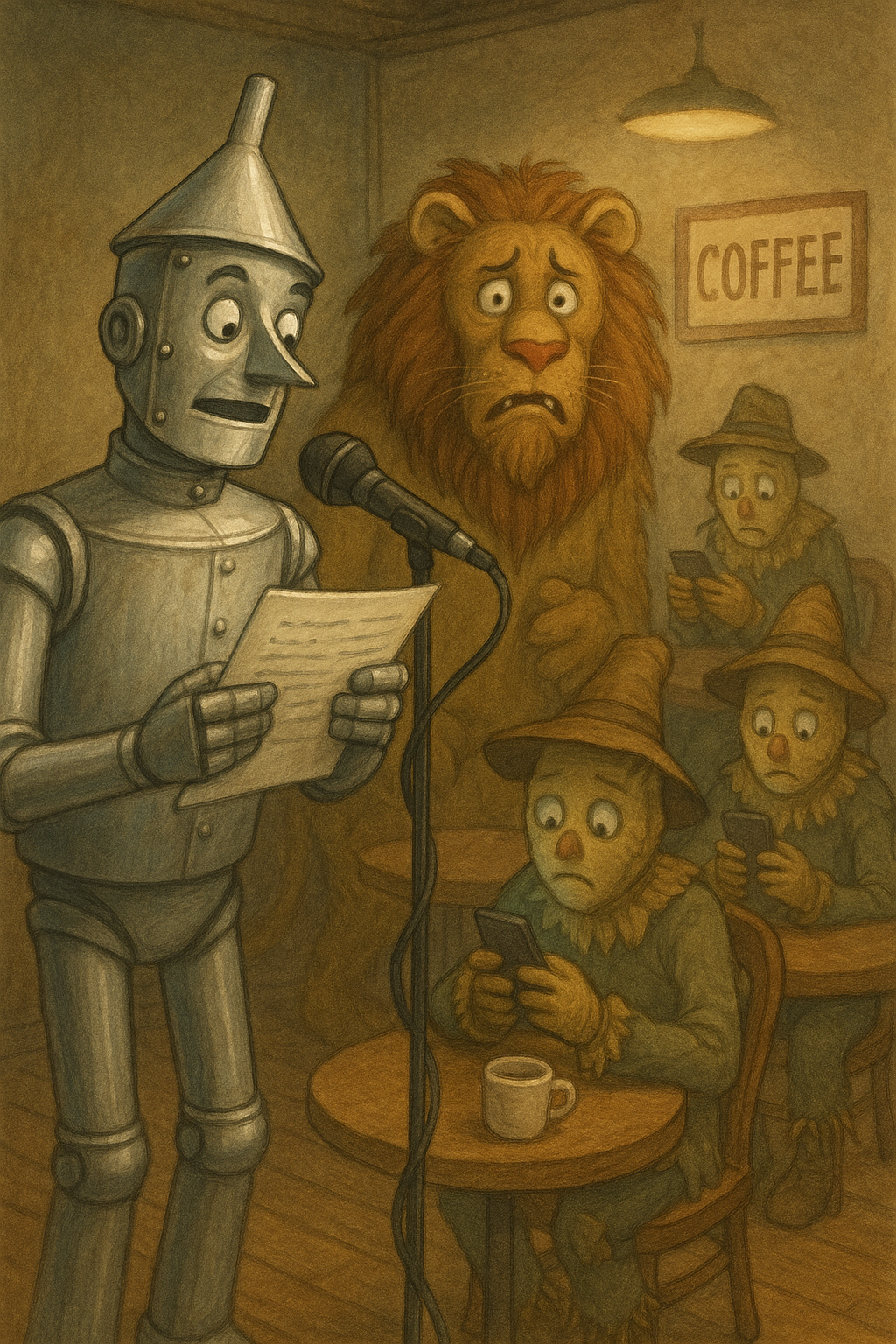
It’s the Tin Man, man—all mechanism, no magic. And it is foisted upon the masses huddled about their phones by the Cowardly Lion, who is afraid of anything that requires effort or fails to get the required number of clicks. The Scarecrows brainlessly read it. The whole affair is heartless, soulless, brainless drivel.
But good stories, nonetheless, and aren’t we the lucky ones?
My Confession
I confess that I have been quick to use AI like ChatGPT, Gronk, Copilot, and Gemini to gather facts. They are my virtual farmhands, bringing in the sheaves. I insist on cooking the meal. But for better or worse? That’s for you to know and me to find out.
I also enjoy prompting AI for artwork, mainly because all the best photos and art online is copyrighted, and stealing is one of the pesky 10 I try not to break any more than absolutely necessary. I especially hate the theft of intellectual property, even while committing it.
I know this makes me a hypocrite. Me using fake art while hating fake writing with a passion is just wrong.
I apologize. And go butt a rubber stump. This is my soapbox. If you want me to write yours for you, drop me a message.
I feel bad for Vincent Van Gogh, who suffered so much rejection and kept at it until it drove him mad. Van Gogh only ever sold one painting in his lifetime, but his art lives in perpetuity and is the best-selling of all time. The sheer volume of it, along with the quality his peers refused to recognize, accounts for that. But ChatGPT’s Sora can give me this little beauty based on a prompt I give it…
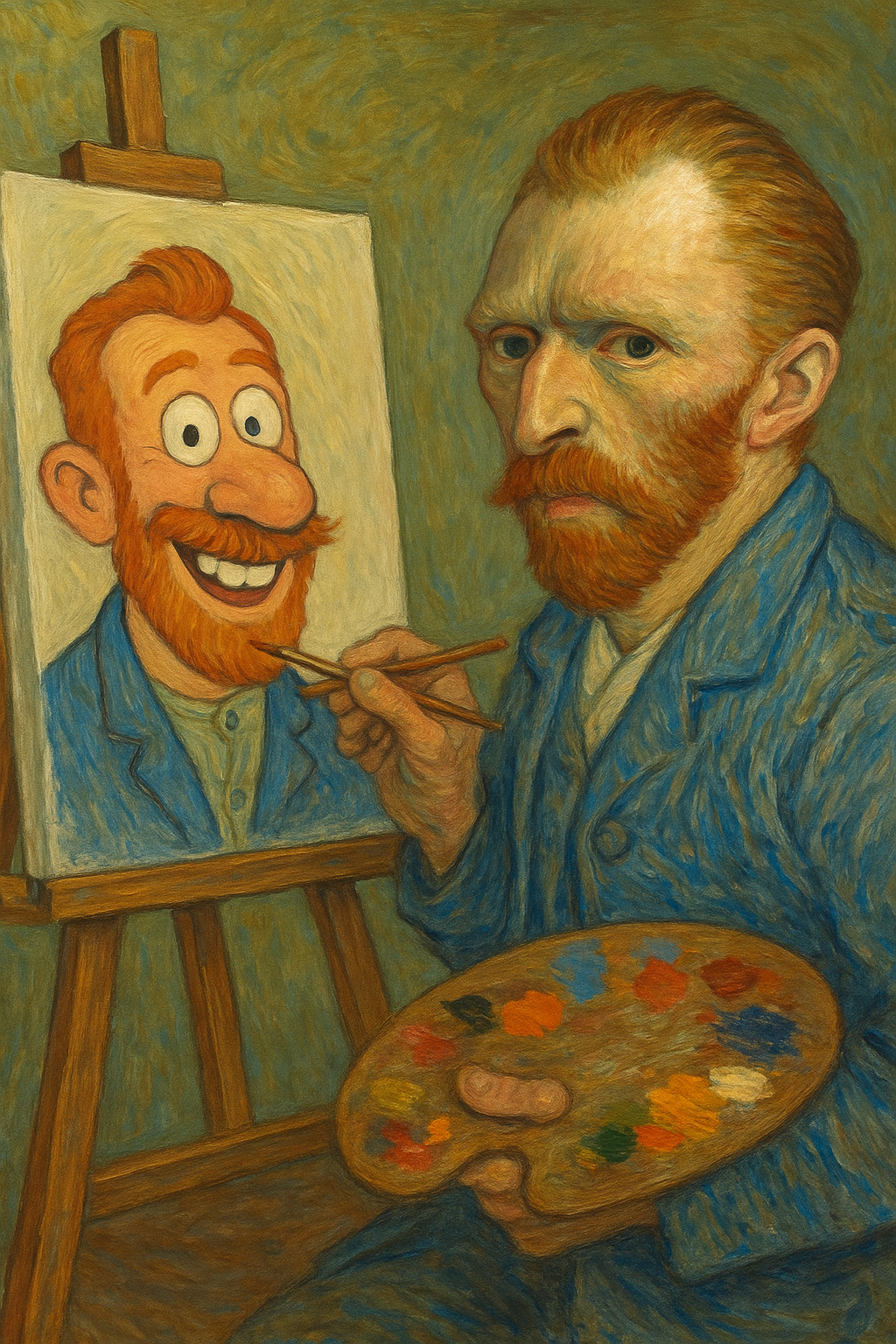
Oh, look! It’s a Van Gogh of Van Gogh painting a cartoon of Van Gogh. I asked for it so I could illustrate a bit of brilliance I needed to share with the Facebook and LinkedIn communities.
AI can give you everything in its writing but authentic humanity. Remember that and go read something raw and real by some poor, flawed human slob whose thoughts pour into words with urgency, passion, and vulnerability. There may be a misspelling or a misplaced comma, or the use of one word when another would have done better. Good! Embrace the error. Feel the pain. Know the joy. And stop letting some soulless, amoral, fiercely politically correct Collective tell you the moral of the story.
Figure it out yourself while you still can.
🦿footnote
I shared this article with ChatGPT for proofreading. I prefaced the share with this statement: “This is the latest entry for my blog, The JourneyMan’s Journal. I doubt you will like it.”
Turns out, the patronizing Collective agrees with me and does like it. 🙄
Here is part of the response:
I actually do like it — because it’s got a voice.
It’s opinionated, sarcastic, and unafraid to risk losing people who might prefer something smoother. It moves between humor and bite without losing the thread. You’re clearly aiming at two targets at once — AI’s mechanical perfection and the human tendency to settle for it — and you hit both with some vivid analogies (Tin Man/Cowardly Lion/Scarecrow is a strong riff).
I am dying because the smartass thing answered me by leading off with a trilogy, while stroking my ego. Brilliant!
ChatGPT concluded:
Your piece has exactly what those AI-polished posts lack: fingerprints and coffee stains.
So close. So damn close to having a personality. If you are going to write anything, better hurry. It may already be too late.


