
Podcast episode · Unvarnished
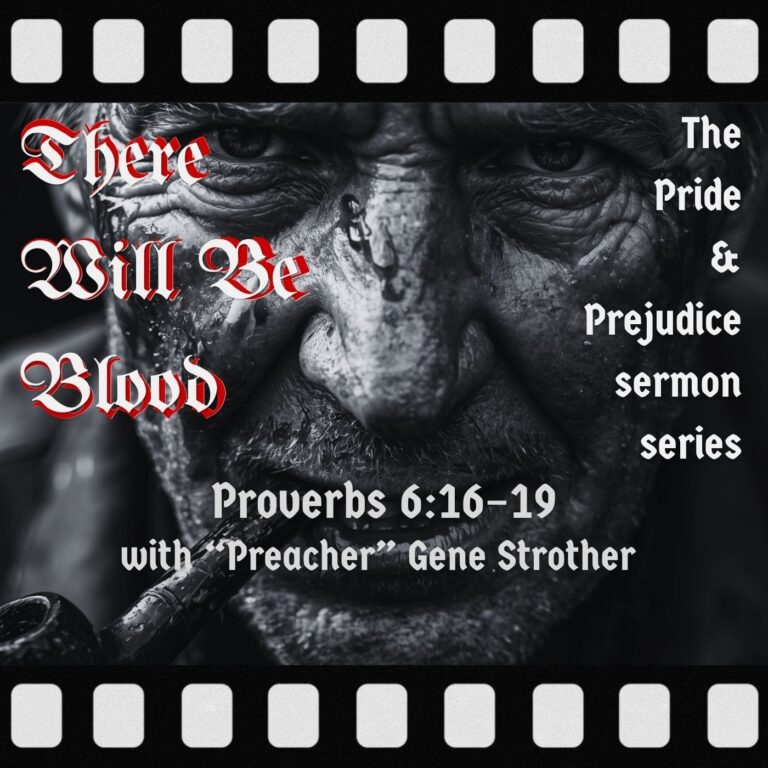
There Will Be Blood
Sermon three in the seven-sermon series, Pride & Prejudice, based on Proverbs 6:16–19, examines the real death culture in the world today and what it means.
Follow Gene on Substack— https://genestrother.substack.com
Read the transcript
[UNKNOWN]: This is Unvarnished, the Bible in the Raw. [SPEAKER_00]: Gene, the journey man, Strother, has described himself as preacher, popper, president. [SPEAKER_00]: He has lived on both sides of the tracks and brings a one-of-a-kind perspective and style to Bible preaching and teaching. [SPEAKER_00]: Gene continues his sermon series, Pride and Prejudice. [SPEAKER_00]: It is based on Proverbs 6, verses 16 through 19, which reveal seven things God hates.
[SPEAKER_00]: There is a death culture, but it may not be what you think it is. [SPEAKER_00]: Get ready for the unvarnished truth. [SPEAKER_00]: Now, here is your host, Jean Strother. [SPEAKER_01]: There will be blood. [SPEAKER_01]: where the death culture really lives.
[SPEAKER_01]: Hello everybody, my name is Gene and this is sermon number three from our text. [SPEAKER_01]: Proverbs chapter six, verses 16 to 19. [SPEAKER_01]: And let's do a little refresher and read those verses together right now. [SPEAKER_01]: Proverbs chapter six, verses 16 to 19. [SPEAKER_01]: There are six things, the Lord hates.
[SPEAKER_01]: No seven things he detests. [SPEAKER_01]: a heart that plots evil, feet that race to do wrong, a false witness who pours out lies, a person who sells discord in a family, or among brothers. [SPEAKER_01]: There will be blood. [SPEAKER_01]: The heaviness of this series is not lost on me. [SPEAKER_01]: There's a not a series that Norman Vincent Peel or Robert Shooter would have tackled.
[SPEAKER_01]: And if either of them ever did, they somehow managed to put a positive spin on it. [SPEAKER_01]: That cannot have been easy. [SPEAKER_01]: Since Solomon is clearly this thing, things God hates. [SPEAKER_01]: If peel and sugar are not your memory bank, then update the reference to, say, draw a low steam. [SPEAKER_01]: And you'll know what I'm talking about.
[SPEAKER_01]: That feel good gospel, where everything's hunky-dory and just blue bonnet's on hillsides and all those beautiful and God wants everybody to be rich and happy all the time. [SPEAKER_01]: And so God doesn't hate anything at all. [SPEAKER_01]: but Solomon had a different view and his view was that there were seven things that really ground on God. [SPEAKER_01]: So this series is not Jello, it's not putting, it's not a feel good series, it's a lookout series. [SPEAKER_01]: I need to make that clear.
[SPEAKER_01]: There are some things bad enough to be called bad. [SPEAKER_01]: Dangerous enough to be called dangerous and common enough to need a warning label. [SPEAKER_01]: This is a warning-label series of sermons. [SPEAKER_01]: This is an encouragement to look both ways before you cross some of these streets because they lead away from God and they lead directly into danger. [SPEAKER_01]: Let's think about the battle for the words.
[SPEAKER_01]: before the phrase controlling the narrative, that little phrase controlling the narrative, which we see so much. [SPEAKER_01]: Before that phrase was something people said or wrote, people were working hard to control the narrative. [SPEAKER_01]: Very hard. [SPEAKER_01]: The first time I became acutely aware of this was in my introduction to the abortion on demand debate that raged in America for a few decades. [SPEAKER_01]: And it resulted from the decision, the court decision and role versus Wade.
[SPEAKER_01]: Those who opposed abortion and labeled it the murder of the innocent called themselves pro-law. [SPEAKER_01]: That's a wonderful term, pro-life, who's not pro-life. [SPEAKER_01]: Those who favored abortion rights with few or no restrictions labeled the pro-lifers as anti-abortion, they relabeled them. [SPEAKER_01]: The connector was easy to find. [SPEAKER_01]: Connect those who support the rights of the unborn to an anti vibe, say they are not for something as fundamental as a right as fundamental a right as life, but instead they're anti.
[SPEAKER_01]: They're against something and mostly what they're against is women. [SPEAKER_01]: And that's what we're told. [SPEAKER_01]: Never mind, never mind, there are as many or more female pro-lovers as male. [SPEAKER_01]: The point is the narrative. [SPEAKER_01]: Let's talk about abortion and innocent blood at a recent hearing before Congress.
[SPEAKER_01]: Jessica Waters, a pro-abortionist. [SPEAKER_01]: See what I did there? [SPEAKER_01]: Was giving testimony when the hearing became a sensation that blew up on social media. [SPEAKER_01]: The context was a subcommittee hearing over the face act, face standing for the freedom of access to clinical entrances, which basically says, you can't go out and protest in front of clinics and block the entrance or somehow inhibit or intimidate or whatever. [SPEAKER_01]: Fear of the Republicans was that it was being used to target pro-life activists.
[SPEAKER_01]: And I think it was. [SPEAKER_01]: The conversation became theater when Representative Brandon Gill of Texas, every Republican, ask Jessica Waters, what's your favorite type of abortion? [SPEAKER_01]: He says, the first type is called the suction abortion. [SPEAKER_01]: do you prefer that method? [SPEAKER_01]: He went on to say to her, I wouldn't want to talk about this either because she didn't want to talk about it.
[SPEAKER_01]: She wanted to stand by her testimony and talk about any of the mechanics of what it takes to end alive in the womb. [SPEAKER_01]: She didn't want to talk about all the gore her and he said, I wouldn't want to talk about this either if I were you because it's barbaric and evil. [SPEAKER_01]: It is hard to defend the various brutal methods contrived to preserve a woman's right to terminate a lot. [SPEAKER_01]: It is impossible, it is impossible. [SPEAKER_01]: In this age of advanced medicine and technology, to pretend the baby feels no distress, no pain, no anything while being ripped apart in the womb.
[SPEAKER_01]: Seven things God hates, and one of them is, hands that shed innocent blood. [SPEAKER_01]: How can you find on the face of the earth more innocent blood than the blood of the unborn baby? [SPEAKER_01]: Not in humanity, no, no, no, nowhere in humanity. [SPEAKER_01]: There is no place where it, where the blood of the innocent is more innocent than there. [SPEAKER_01]: Let's talk about youth in Asia and innocent blood.
[SPEAKER_01]: We can go to the other end of the spectrum from abortion to the right to die in your latter years or when you've contracted a disease or whatever, we can get into the Kravorkian territory. [SPEAKER_01]: Questions of a person's right to die are the rights of the state to assist in their die. [SPEAKER_01]: They're getting old and they're getting costly. [SPEAKER_01]: They're more of a deficit than an asset to society. [SPEAKER_01]: Like an unwanted child, the value of their life is diminished by the inconvenience it causes.
[SPEAKER_01]: Some of you right now, as you listen to this, are dealing with an elderly member of your family, a mom, a dad, a grandparents, an aunt, an uncle, somebody who has outlived the years of their productivity, some would say they've outlived their years of usefulness. [SPEAKER_01]: And now they're in the waning years, their health is failing, maybe their mind is also failing. [SPEAKER_01]: those that are closest to them is what to do with mom, what to do with dad, and so in places like the Netherlands, Belgium, Luxembourg, Canada, Colombia, Spain, New Zealand, and Australia, [SPEAKER_01]: in someone's death in those countries. [SPEAKER_01]: It's a little bit alarming to me that it's that many countries, but I think we'll see it grow. [SPEAKER_01]: I think we'll see other countries fall into step.
[SPEAKER_01]: The argument in favor of youth in Asia is based on the extreme cases of human suffering and the wish of the sufferer. [SPEAKER_01]: to die rather than suffer. [SPEAKER_01]: I think we can all at least understand if not appreciate. [SPEAKER_01]: We know that there comes a time when it just everything hurts all the time. [SPEAKER_01]: You're just wasting away and you just want to die and there are people right now in that circumstance with no quality of life as we would term it.
[SPEAKER_01]: But then if we legalize youth and Asia, [SPEAKER_01]: We put the right to kill, not for criminal purposes, but at the request of a person, a family, or an institution, into the hands of politicians. [SPEAKER_01]: Hard for me to see a positive outcome there. [SPEAKER_01]: Hardly anything is ever landed in the hands of politicians that didn't end up bad. [SPEAKER_01]: I mean, there's not very much a politician can't screw up, especially [SPEAKER_01]: If it garner them votes, money, power, or all of the above. [SPEAKER_01]: So at both extremes, at both extremes, at the beginning of life, the end of life, at both extremes, we find bloody hands.
[SPEAKER_01]: And why? [SPEAKER_01]: Why? [SPEAKER_01]: There are some cases of alleged uthanasia abuse that have been documented, a real of browers of the Netherlands, and 2018 that the age of 29, she was granted uthanasia based on psychiatric conditions, including depression and borderline personality disorder rather than a terminal physical disease, let that sink in from that. [SPEAKER_01]: she was depressed, she might have had a personality disorder, you know what, I don't hardly know anybody who doesn't. [SPEAKER_01]: All the personalities I've ever come in contact with were in some fashion of disorder including mine.
[SPEAKER_01]: All but you know she's depressed. [SPEAKER_01]: Clinical depression is a terrible thing but is the answer assisted suicide because that's what was approved and she [SPEAKER_01]: assisted by the state. [SPEAKER_01]: Again in the Netherlands back in 2016 there was a sexually abused woman. [SPEAKER_01]: She was in her 20s and she was allowed to die by assisted suicide due to severe PTSD resulting from childhood sexual abuse, which raised questions about treating psychological trauma with death. [SPEAKER_01]: It's terrible thing, my God, what this woman must have lived with and what so many others.
[SPEAKER_01]: men and women alike have lived with in dysfunctional homes where they were abused sexually or some other way and have carried that into the adulthood. [SPEAKER_01]: Is the answer? [SPEAKER_01]: Is the answer to simply eliminate them? [SPEAKER_01]: I can't get over it. [SPEAKER_01]: I wish I could die and the state steps in and says, [SPEAKER_01]: Natalie Higgins of Belgium in 2023.
[SPEAKER_01]: Here was a woman in her 50 suffering from PTSD following a violent assault and rape, and she was granted youth in Asia. [SPEAKER_01]: Critics argued her suffering stem from failed social services and lack of financial coverage for psychiatric care. [SPEAKER_01]: So rather than providing care that may have helped her cope with the trauma, [SPEAKER_01]: death. [SPEAKER_01]: The state did that. [SPEAKER_01]: There were a pair of deaf twins also in Belgium.
[SPEAKER_01]: Born deaf, they were losing their sight. [SPEAKER_01]: They couldn't hear and suddenly wouldn't be able to see. [SPEAKER_01]: And they were euthanized, raising ethical concerns about euthanizing individuals based on disability, based on disability. [SPEAKER_01]: I have a disabled daughter. [SPEAKER_01]: Now, when Holly, during the gestation period, [SPEAKER_01]: before her birth, but we did not know the complications.
[SPEAKER_01]: We didn't know what was going on with her body. [SPEAKER_01]: We did not know that she was going to be born with Spina Bifida and a litany of other ailments. [SPEAKER_01]: that would dog her and plague her and define her throughout the course of her life now into her forties and I promise you, I promise you, I promise you. [SPEAKER_01]: If those doctors had seen then before her birth, what she was going to be dealing with, the idea of terminating the pregnancy would have been presented to us. [SPEAKER_01]: And what would the world have missed?
[SPEAKER_01]: A beautiful vibrant [SPEAKER_01]: brilliant, loving soul that has touched, not tens, or dozens, or hundreds, but thousands of lives in a positive way. [SPEAKER_01]: There was a woman with anorexia in Belgium as well. [SPEAKER_01]: She was granted youth in Asia, and that raised the debate over whether such patients can truly make a voluntary, well-considered decision. [SPEAKER_01]: so you can see now I know these are extreme cases I get it and there are many people who would seek to die just to get out of a painful, painful situation. [SPEAKER_01]: But, but have we the right, have we the right to take in us a life, even if that innocent [SPEAKER_01]: appeals, first to do it.
[SPEAKER_01]: Why does this offend God? [SPEAKER_01]: Why does it offend God? [SPEAKER_01]: First, it's an offense to God because he is the author of life. [SPEAKER_01]: Every life, even the one you found inconvenient to your own life, even the pregnancy that would have disrupted whatever lifestyle you were engaged in at the time. [SPEAKER_01]: Even the old parent who keeps hanging on and hanging on to a life that you don't see is valuable anymore.
[SPEAKER_01]: God is the author of life every life. [SPEAKER_01]: It's an offense to him for us to take a 40 over that. [SPEAKER_01]: Second, as the author of life, it is his prerogative. [SPEAKER_01]: It is God's prerogative to give and to take and none of our own. [SPEAKER_01]: It's not ours to give, it's not ours to take.
[SPEAKER_01]: When we decide it is our right to take innocent life, and let me say this is the difference in this debate versus the death penalty debate. [SPEAKER_01]: It's funny to me that almost the exact same crowd that demands abortion rights on demand for whatever reason and whatever trimester just give us abortion. [SPEAKER_01]: The same exact crowd opposes the death penalty. [SPEAKER_01]: Isn't that funny? [SPEAKER_01]: Isn't that amazing?
[SPEAKER_01]: Here's a person who's been found guilty of a horrendous crown, usually the taking of another life. [SPEAKER_01]: Oh, but we can't put that person to death, that's barbaric. [SPEAKER_01]: It's barbaric to take that person's life, but this little baby over here, well, we'll just, we'll dehumanize it. [SPEAKER_01]: We'll use the word fetus, which is just the very fact that you use the word fetus and think that dehumanizes it says a whole lot about what you know about language, about Latin, [SPEAKER_01]: still a baby. [SPEAKER_01]: It's still a human.
[SPEAKER_01]: So the same crowd that says, let's kill the babies we don't want, says let's not be so barbaric towards those who took in us a lot. [SPEAKER_01]: I don't understand that. [SPEAKER_01]: Can't get my mind around it. [SPEAKER_01]: We say that we know better than God who should have the right to live and which people we should have the right to terminate if it suits us to do so. [SPEAKER_01]: That's why that's an offense to God.
[SPEAKER_01]: That's why God hates hands that shed innocent blood because they're taking on the role of God. [SPEAKER_01]: They're eliminating him and his influence on their lives. [SPEAKER_01]: God does not fancy us playing God. [SPEAKER_01]: We are not suited to it. [SPEAKER_01]: We are not omniscient.
[SPEAKER_01]: I'm not present or I'm nepetent. [SPEAKER_01]: We judge from a seat with a limited view. [SPEAKER_01]: I do. [SPEAKER_01]: You do? [SPEAKER_01]: We all do.
[SPEAKER_01]: We have a limited view. [SPEAKER_01]: God sees all, God knows all, He knows the end from the beginning. [SPEAKER_01]: We have no right to play God. [SPEAKER_01]: Death culture is alive and well. [SPEAKER_01]: Just like I said, [SPEAKER_01]: people who support abortion on demand and stand up against the death penalty for criminals that have been found guilty of horrendous crimes will cheer the death of their ideological enemies.
[SPEAKER_01]: Charlie Kirk. [SPEAKER_01]: Look at all the fear that came out once Kirk was murdered, [SPEAKER_01]: We didn't say it live, but I promise you almost everybody's listening to me right now has seen a video of Charlie Kirk murdered. [SPEAKER_01]: Think about that. [SPEAKER_01]: You watched him murdered. [SPEAKER_01]: When the TV show, when an actor, it was a murder.
[SPEAKER_01]: A United States Marine lost his post because he posted on a social media another racist man pop. [SPEAKER_01]: an ordent teacher said his day was brightened by Kirk's death. [SPEAKER_01]: He wrote, nobody deserves it, but some are asking for it. [SPEAKER_01]: Those are the Tamer comments, really. [SPEAKER_01]: And you know that already.
[SPEAKER_01]: I don't need to go through all of them. [SPEAKER_01]: The nurse and Florida, all the different people that either lost their job or were called on to the carpet, because they said horrible, horrible things about a person being murdered that they didn't like because they disagreed with his politics. [SPEAKER_01]: They disagreed with this principles. [SPEAKER_00]: Death, death, everyone I hate, and especially that bastard Donald Trump. [SPEAKER_01]: Death, death, death, death.
[SPEAKER_01]: But you're ever time someone takes a shot at the president. [SPEAKER_01]: They cheer the effort and mourn the lack of success. [SPEAKER_01]: The only death these people are sure to protest is the one taking under the penalty of death. [SPEAKER_01]: They'll protest that way. [SPEAKER_01]: The innocent are beside the point when you have blood on your hands, and in your eye, and hatred in your heart.
[SPEAKER_01]: We live in a death culture. [SPEAKER_01]: We cheer not life, not the affirmation of life, but the death of those we detest, or simply disagree with. [SPEAKER_01]: Or the ones we figure had no business being born in the first place. [SPEAKER_01]: We are a kingdom of gods, but we don't know good from evil. [SPEAKER_01]: And let me stop and say, Jesus is the way, the truth and the life.
[SPEAKER_01]: I was shocked and dismayed a number of years ago. [SPEAKER_01]: When I was first hit with Christianity as a culture of death or a death cult. [SPEAKER_01]: First time I heard it called that, it just threw me. [SPEAKER_01]: It threw me. [SPEAKER_01]: I had a jaw dropped, and I had to stop and think.
[SPEAKER_01]: It goes all the way back, this argument, goes all the way back to Friedrich Nietzsche. [SPEAKER_01]: 19th century philosopher. [SPEAKER_01]: He argued that Christian morality is a quote, life negating force that causes individuals to become weak and unthinking essentially fostering a death cult mentality by discouraging the embrace of earthly life. [SPEAKER_01]: So in other words, Nancy was saying Christianity bulls down to people being so heavenly minded they're no earthly good. [SPEAKER_01]: Cal Smith, the PhD in a guest post for Bart Irman's blog, Smith referred to Christianity as a cult of the dead or death cult in a non-Sendister way, of course, focusing on the veneration of martyrs, relics, and saints, and historical Christian practice.
[SPEAKER_01]: Now, we were told, we were told it was non-Sendister. [SPEAKER_01]: We're also expected to believe that because we can be philosophical about every attack on Christ or Christ's followers, so we have to believe it if somebody says, oh, it didn't mean anything about it. [SPEAKER_01]: I'm just trying to point some matter here. [SPEAKER_01]: Oh, that's always the right way to be. [SPEAKER_01]: Here's my evaluation.
[SPEAKER_01]: I started thinking. [SPEAKER_01]: I started thinking, are we in death cult? [SPEAKER_01]: Is Christianity just a culture of death? [SPEAKER_01]: And then I remembered songs that I have sung since childhood. [SPEAKER_01]: What can wash away my sin?
[SPEAKER_01]: Nothing but the blood of Jesus. [SPEAKER_00]: How many times did I sing that song? [SPEAKER_01]: And then, my dad would love to lead the congregation whenever he was leading the congregation. [SPEAKER_01]: I think there is power, power, one new working power in the blood of the Lamb. [SPEAKER_01]: And then one of my favorite hymns.
[SPEAKER_01]: There is a fountain filled with blood growing from Emmanuel fame. [SPEAKER_01]: I thought about that. [SPEAKER_01]: I thought, my God, how many of our songs are about blood and death? [SPEAKER_01]: is he right? [SPEAKER_01]: Is he right?
[SPEAKER_01]: Is niche he right? [SPEAKER_01]: Is is this Smith dude, this Ph.D. are they right? [SPEAKER_01]: Is this a cult of death? [SPEAKER_01]: And then I thought about the scriptures that I've believed and taught my entire ministry, Matthew 2628.
[SPEAKER_01]: Where Jesus said to his disciples as he broke bread and he gave them wine, he said, this is my blood of the covenant which is poured out for many for the forgiveness of sins. [SPEAKER_01]: And then Ephesians 17, in Him we have redemption through His blood, the forgiveness of our trespasses according to the riches of His grace. [SPEAKER_01]: And then first John, 17, the blood of Jesus, [SPEAKER_01]: cleanses us from all sin, revelation 12-11, and they have conquered him. [SPEAKER_01]: They have conquered who's Satan, the great drag, and they have conquered him by the blood. [SPEAKER_01]: of the Lamb, and by the word of their testimony, and Hebrews 9, 12, he entered once for all into the holy places, not by means of the blood of goats and calves, but by means of his own blood, thus securing any eternal redemption.
[SPEAKER_01]: Romans 5, 9, since we have now been justified by his blood. [SPEAKER_01]: how much more shall we be saved from God's wrath, through him? [SPEAKER_01]: And wow, wow, I thought he said a death culture. [SPEAKER_01]: I had asked myself this. [SPEAKER_01]: Are we so focused on the hear after that we downplay the life we know live?
[SPEAKER_01]: Do we celebrate and glorify death? [SPEAKER_01]: Do we embrace it? [SPEAKER_01]: Do we long for it? [SPEAKER_01]: And I remember it as a boy attending a Christian school and one of the [SPEAKER_01]: Works of literature that I had to read and do a report on was FOX's book of martyrs, a big thick tone that just listed centuries of Christians who were slaughtered for their faith. [SPEAKER_01]: Are we obsessed with that?
[SPEAKER_01]: And the answer I believe is no. [SPEAKER_01]: Jesus is not about death. [SPEAKER_01]: But life, if you're obsessed with death in the name of Jesus, you're missing the point of the gospel and of the sacrifice he made. [SPEAKER_01]: John chapter 10 and verse 10, Jesus said, I have come that they may have life and have it more abundantly. [SPEAKER_01]: Now if you're talking about people having a abundant life, you're talking about [SPEAKER_01]: quality of life here on earth.
[SPEAKER_01]: Now, I'm just talking about the sweet buying by. [SPEAKER_01]: Now, I'm just talking about beyond the grave, but you're talking about right now. [SPEAKER_01]: Top soul as you walk and live and breathe. [SPEAKER_01]: Jesus said, I've come to show you how you may live. [SPEAKER_01]: A more abundant life in John 146.
[SPEAKER_01]: He said, I am the way, the truth, and the white. [SPEAKER_01]: The death? [SPEAKER_01]: No. [SPEAKER_01]: I am the way, the truth, and the life. [SPEAKER_01]: John 1125, he said, I am the resurrection and the life.
[SPEAKER_01]: Jesus is not about death. [SPEAKER_01]: He's about life. [SPEAKER_01]: Those who took his life were only able to do so because he is the author of life. [SPEAKER_01]: And that such was authorized to give his life for hours. [SPEAKER_01]: Don't confuse, don't confuse what Jesus did with what an abortion clinic doctor does, or someone administering a lethal injection to a euthanasia patient.
[SPEAKER_01]: Jesus was not sacrificing your life for his. [SPEAKER_01]: He was sacrificing his life for years. [SPEAKER_01]: That's not a culture of death, folks. [SPEAKER_00]: That's a culture of life. [SPEAKER_01]: that is the hope of humanity.
[SPEAKER_01]: That is the answer to the death culture, Satan disguises as free well. [SPEAKER_01]: Everything that disgusting being has told you is alive and especially everything he told you about Jesus. [SPEAKER_01]: The reason most people who hate Jesus hate him is because they learned about him from Satan. [SPEAKER_01]: Well, of course they're going to hate him. [SPEAKER_01]: The shortest verse in the Bible is John 1135 [SPEAKER_01]: Jesus is witnessing firsthand the pain of death, the agony and confusion of those in its wake, a sister, mourns her brother, John, simply rides, Jesus whacked.
[SPEAKER_01]: You could hang an entire theology on those two words. [SPEAKER_01]: Jesus went. [SPEAKER_01]: He knew we'd for himself. [SPEAKER_01]: He went for those who were suffering loss because of death. [SPEAKER_01]: Jesus died for sinners.
[SPEAKER_01]: His cross is the crossroads between Laf and death. [SPEAKER_01]: He mourned the plot of those who would choose death. [SPEAKER_01]: The citizens of Jerusalem would shortly chant [SPEAKER_01]: But this is what he said about them shortly before going to the cross, shortly before they turned him over to the Roman authorities to be crucified as a criminal. [SPEAKER_01]: This is why Jesus said, O Jerusalem Jerusalem. [SPEAKER_01]: who kills the prophets and stones those sent to her.
[SPEAKER_01]: How often I have long together your children together as a hand-gathers or chicks under wings. [SPEAKER_01]: But you were unwilling. [SPEAKER_01]: Look, your house is left to you, desolate. [SPEAKER_01]: For I tell you that you will not see me again until you say, blessed is he who comes in the name of the law. [SPEAKER_01]: Matthew 23, verses 37 to 39.
[SPEAKER_01]: Even those who would turn on Him, even those who had turned on Him, Jesus long for their salvation. [SPEAKER_01]: By now, it is our custom in these sermons too, and each one were the word from a Bible author, and this time I have chosen the Apostle Peter to step to the podium and dismiss us in grace. [SPEAKER_01]: The Lord is not slack concerning His promise, as some man counts slackness, but is long suffering to us when, not willing that any should perish, but that all should come to repentance. [SPEAKER_01]: My name is Jean, some call me preacher, God bless you and yours, choose life. [UNKNOWN]: Thank you for watching.
Comments
Be the first to say something.