0
0
 0
0
a storm-chaser’s cautionary tale
Sin has a long tail.
In 2005, I was still making interest payments on past sins that were more than a decade old. I thought a few times about throwing myself off a bridge. Instead, I hurled myself into the deep end of the most notorious American hurricane—a history-maker they named Katrina.
I found a new path but I brought along old habits, and an irreversible, unrepentant calling. Now more than two decades in, the journey has brought me hard-earned experience and a measure of success I didn’t dream plausible.
Along the way, I sat down in a cubicle in Mobile, Alabama, and stayed for a year-and-a-half on what was supposed to be a three-week deployment.
Storms kept coming and I kept staying.
There, I met a man who would become a fast friend—an expressive man with plenty to say and a colorful way of saying it.
“This storm is going to have a long tail on her,” he said.
“What do you mean?”
“It will take a good while to put it to bed. Claims will open and reopen and reopen again. We’ll be here a while.”
I don’t recall which storm it was but he was right. Some storms take years, not months to put to bed.
That was the first time but hardly the last I heard about complicated storms having long tails. I call them ‘long-tailed CATs (catastrophes).’
Sin, too, is a long-tailed cat…with teeth and claws. It often comes with consequences that take years, generations even, to wear themselves out.
The Law of Sowing and Reaping
Be not deceived; God is not mocked: for whatsoever a man soweth, that shall he also reap –Galatians 6:7
There is plenty to unpack there.
“Don’t fool yourself,” Paul says, “Into thinking you got away with it. God doesn’t rush to judgment and sometimes it isn’t His judgment at all that is in play – It is the law of sowing and reaping.
This famous declaration from the Apostle Paul addresses a scientific and spiritual truth woven into the fabric of God’s creation; that is, you reap what you sow. First, there is the planting, and then there is the harvest.
The Greek word for sow in this passage refers to one’s actions, behaviors, investments of time, and attitudes. It is a continuous, habitual sowing.
Current Events
Watching the world roil and reel these past days, with Israel and the United States raining judgment on an unholy, inhuman, ungodly regime, is a stark reminder of the consequences of sin. These evil men who murdered their own people by the tens of thousands, who promised death and destruction to Israel and America, their religious and ideological enemies, seem to have reached payday. It was a long time coming.
Meanwhile, in America, a feeble, elderly former president sits before Congress answering for his sins, telling whatever lies he can remember to cover the tracks of a sordid and debauched life. He no longer has the cover of his wife. She, too, is in damage control, mostly because of his decisions. His political party is content to abandon him and leave him to pay the fiddler alone. He is old news and nobody’s champion.
Sin can be a fun cat to pet, but it has a long, long tail.
How the Law of Sowing and Reaping Works
You reap what you sow. If you sow corn, you aren’t looking for okra or potatoes when harvest comes.
You reap after you sow. There is a gestation period. Harvest is not immediate.
You reap as you sow. While you are sowing today’s seeds, you are reaping from the seeds already sown.
You reap more than you sow. From a few kernels comes a corn stalk. On that corn stalk is one or two ears of corn. On each ear (or cob) is 500–1200 kernels of corn.
How the Law of Sin Works
Sin takes you further than you intended to go. No one starts off to be a junkie or a prostitute or career thief or murderer. Well, not many do. But sin is a slope and that slope is slippery.
Sin keeps you longer than you want to stay. Habits, like iron chains, are hard to break. Passion becomes a pattern and then a prison.
Sin costs you more than you want to pay. Oh, how much money is spent on therapy and other solutions to mitigate the consequences of habitual sin? Government-funded programs, medications, private therapists, retreats…and that is just one kind of cost. Other kinds include disease, relational destruction, and waning self-worth.
Passion becomes a pattern and then a prison.
How can so little a first step become a path of destruction?
In his famous sermon Payday Someday, R. G. Lee, a notable Southern Baptist pastor from a past generation quoted a poem written by Paul Lawrence Dunbar:
THE DEBT
This is the debt I pay
Just for one riotous day,
Years of regret and grief,
Sorrow without relief.

Pay it I will to the end—
Until the grave, my friend,
Gives me a true release—
Gives me the clasp of peace.

Slight was the thing I bought,
Small was the debt I thought,
Poor was the loan at best—
God! but the interest!
King David, a man God approved as king and one who passionately pursued a relationship with God, found himself on that slippery slope of sin. It was a path of adultery, cover-up, denial, and murder-by-proxy. The consequences of that sin included the loss of a child.
David lived the rest of his life with the regret of that sin.
Study David’s prayer, which was put to music and sung, in Psalm 51:
For the choirmaster. A Psalm of David. When Nathan the prophet came to him after his adultery with Bathsheba.
Have mercy on me, O God,
according to Your loving devotion;
according to Your great compassion,
blot out my transgressions.Wash me clean of my iniquity
and cleanse me from my sin.
For I know my transgressions,
and my sin is always before me.
Against You, You only, have I sinned
and done what is evil in Your sight,
so that You may be proved right when You speak
and blameless when You judge.
Surely I was brought forth in iniquity;
I was sinful when my mother conceived me.
Surely You desire truth in the inmost being;
You teach me wisdom in the inmost place.
Purify me with hyssop, and I will be clean;
wash me, and I will be whiter than snow.
Let me hear joy and gladness;
let the bones You have crushed rejoice.
Hide Your face from my sins
and blot out all my iniquities.
Create in me a clean heart, O God,
and renew a right spirit within me.
Cast me not away from Your presence;
take not Your Holy Spirit from me.
Restore to me the joy of Your salvation,
and sustain me with a willing spirit.
Then I will teach transgressors Your ways,
and sinners will return to You.
These are the words I find so haunting and sad: For I know my transgressions,
and my sin is always before me.
King David sought forgiveness from God and received it. He also sought the divine strength to overcome sin’s powerful pull. He would be an example for others, a cautionary tale of sin’s awful price. He would use his experience and his failure to warn others and teach them a better way.
Cain, the first recorded murderer, killed his brother in a fit of jealous rage. He became a marked man, a scourge. Unlike King David, he never sought forgiveness. Instead, he lived in bitter defiance and self-pity.
In Genesis 4:13, he is recorded saying, My punishment is greater than I can bear.
Cain was essentially accusing God of unfairness in his judgment.
David was repentant. Cain was defiant. David’s story is one of redemption and the attainment of human greatness. Cain’s is a story of wasted potential and lonely wandering.
Sin has a long tail.
How the Law of Christ Works
What about forgiveness of sin? What about redemption?
Salvation is freedom from the condemnation of sin, but not the consequences
The Adulteress
Jesus Christ was brought a woman caught in the act of adultery. His words caused her accusers and would-be executioners to walk away in shame.
Jesus said to her, “Neither do I condemn you. Go and sin no more.”
He was not freeing her from the consequences at home, where a betrayed husband was sorting through the wreckage of her sin or where her children were dealing with the humiliation, or where the community was ostracizing her. He freed her from condemnation, the eternal price of sin.
He was also not burdening her with perfection when he said, “Go and sin no more.”
He was saying, “Do not continue the same path. Change your ways.”
The appropriate response to forgiveness is gratitude and determination to do better.
If you owe a financial debt greater than you can pay and some angel comes along (perhaps a parent or other mentor or friend) and pays off the debt, not as a loan, but a gift, the most inappropriate thing you can do is rack up more debt.
The Thief
Jesus Christ was crucified like a common criminal with common criminals. One of them mocked him. The other worshiped. The one who worshiped asked to be remembered by Jesus in the afterlife. He sought redemption and he got it.
Jesus promised, “Today, you will be with me in Paradise.”
Both men still died, condemned. They suffered the consequences of sin, but the one who sought salvation was freed from sin’s eternal condemnation.
Like the adulteress or the thief, even the “worst” sinners, the ones whose lives are most horribly lived, whose sins cost themselves and others untold srorrows, can be saved from the eternal condemnation of sin, from the judgment of righteous God.
Why?
Because of the One who died between the thieves, the man in the middle, the Mediator between God and man, who died not for the consequences of His sin but for the condemnation of yours, and mine, and adulterers, and thieves, and murderers, and moms, and dads, and kids…
For Christ’s love compels us, because we are convinced that One died for all, therefore all died. And He died for all, that those who live should no longer live for themselves, but for Him who died for them and was raised again. –2 Corinthians 5:14,15
…Christ…suffered once for sins, the righteous for the unrighteous, so that He might bring you to God, having been put to death indeed in the flesh, but having been made alive in the spirit… –1 Peter 3:18
Sin is a long-tailed cat. Beware its consequences.
I will let no less an authority than the Apostle Paul close this sermon and tell you in no uncertain terms about the forgiveness of sin and the new life available in Jesus Christ
What then shall we say? Shall we continue in sin so that grace may increase? Certainly not! How can we who died to sin live in it any longer? Or aren’t you aware that all of us who were baptized into Christ Jesus were baptized into His death? We were therefore buried with Him through baptism into death, in order that, just as Christ was raised from the dead through the glory of the Father, we too may walk in newness of life.
For if we have been united with Him like this in His death, we will certainly also be united with Him in His resurrection. We know that our old self was crucified with Him so that the body of sin might be rendered powerless, that we should no longer be slaves to sin. For anyone who has died has been freed from sin.
Now if we died with Christ, we believe that we will also live with Him. For we know that since Christ was raised from the dead, He cannot die again; death no longer has dominion over Him. The death He died, He died to sin once for all; but the life He lives, He lives to God. So you too must count yourselves dead to sin, but alive to God in Christ Jesus.
Romans 6:1–8
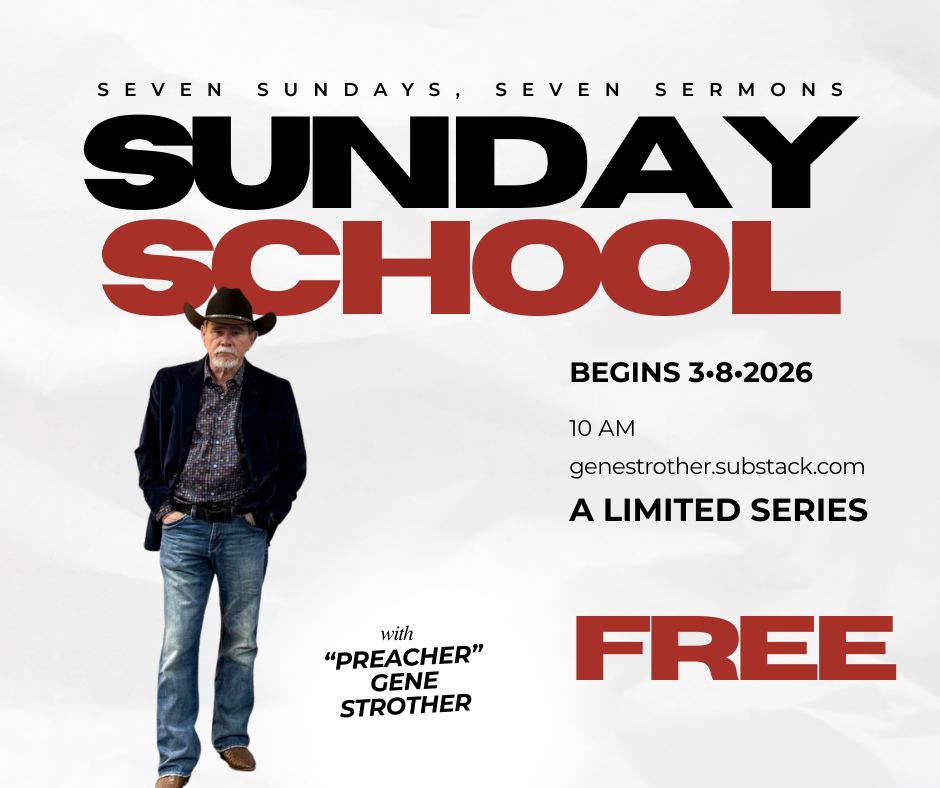
My name is Gene. Some call me Preacher. And this is sermon one in the seven-sermon series, Sunday School.